The platform beneath the reports: Microsoft Fabric as the new data foundation at Telefónica Germany

The task
Telefónica Germany had run a reporting landscape on Tableau that had grown over years: 1,000 reports from 300 employees, plus extracts, data copies and variants of the same analysis in different teams. Laura Ortner, Senior License Manager at Telefónica Germany, describes the starting point in her talk as “a sprawling, uncontrolled reporting ecosystem that nobody fully owned and nobody controlled”. The first question was what this estate cost. The answer led to a second question: what of it does the company actually need, and what should it run on in future?
The obvious route would have been to transfer the reports one to one into another BI tool. Telefónica would then have had the same landscape under a different name: the same copies, the same shadow extracts, the same maintenance. Our brief was a different one: a data platform on Microsoft Fabric on which the reports share one data estate, permissions are managed in one place and operations stay with the in-house team. Power BI as the user interface was the visible part, and the smaller one.

The approach
The inventory came first, the platform after. Usage data showed which reports were being opened and which nobody had looked at for months. A comparison of data sources showed where several workbooks loaded the same table, each in its own way. Redundancies were identified, duplicates merged, naming conventions and data structures reworked. What nobody used did not move at all.
Then the foundation was built, once and properly: OneLake as the shared storage, a lakehouse on top of it in which the data sits once and is used jointly by pipelines, semantic models and reports. Shadow extracts that ran overnight with results nobody checked became traceable load processes. Many copies of the same table became one data estate.

We managed permissions centrally, through roles in the semantic model and distribution via workspaces and apps, rather than afresh in every report. Deployments run through pipelines from development via test to production and leave an audit trail. Fabric capacity is measured and managed so that the costs of the new world do not grow as unnoticed as those of the old one. None of this is visible in a report. In operations it is noticeable every day.
The reports moved in waves, the most complex first, so that the rest became routine. Tableau and Power BI think differently; we translated the patterns rather than the formulas. Each wave was reconciled against the old world and signed off by the business before the switch. Old and new platform ran in parallel until the numbers matched. Telefónica’s development team worked on every wave, on the real estate and on the new platform. A comprehensive training programme ran alongside from the first wave.
“Change is hard. Reporting shouldn’t be.”



The outcome
After eleven months the last wave was signed off and Tableau was switched off. The licence ended, and with it the operation of a platform nobody needed any more. Throughout that time reporting kept running for 300 employees, without a single day of downtime.
What remains is what it was about from the start: one data estate in OneLake instead of many copies, permissions in one place instead of in every report, deployments with an audit trail and a capacity whose costs are visible. The reports run in Power BI on this foundation. The same data is now ready for what comes next: Copilot, analyses across departmental boundaries and AI agents, which need reliable data before they can say anything reliable.
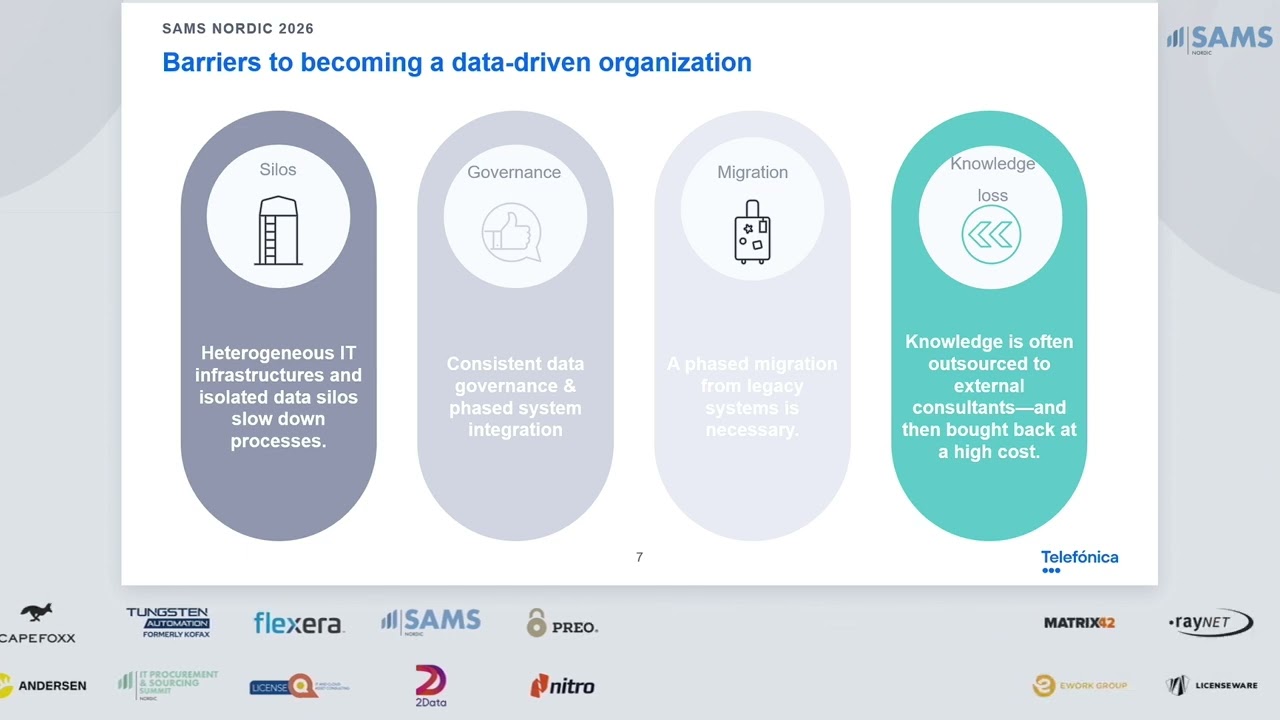
One of the barriers to becoming a data-driven organisation is named by Telefónica itself in its talk: “Knowledge is often outsourced to external consultants”, and then has to be bought back at a high cost. That is why the platform sits where it belongs: in Telefónica’s own environment, under its own licences, documented in architecture, permissions and deployments, carried by its own team.
Outlook
A data platform is finished when it runs without us. What is built on it is for Telefónica to decide: further sources added to OneLake, departments building their analyses on the same data estate, and agents working on exactly this foundation. The foundation carries more than the 1,000 reports it started with.
For us the project is the benchmark against which we measure every migration to Microsoft Fabric: survey the estate, build the foundation once and properly, migrate in waves, run in parallel, switch off, hand over. With us or without us.
Let’s talk about your data platform.
Tell us where you are and what you want to replace or build. We will get back to you shortly with an initial assessment.
You talk directly to our managing directors.

Piero Alessio
Managing Director
Thank you, your enquiry has reached us.
We will get back to you shortly.